

Showing top 0 results 0 results found
Showing top 0 results 0 results found



Banking processes that were once completed in person have shifted online: depositing checks, transferring funds, and paying bills. Calling a customer service line and waiting for an agent? That's not something most customers tolerate anymore.
Digital apps and AI chatbots have moved to the front stage.
This shift in customer behavior calls for a banking chatbot that can handle real conversations, not just route people through menus. The right one builds trust with existing customers, converts new ones, and takes pressure off your team.
In this guide, I'll walk through everything you need to know about chatbots in banking: the benefits, the most common applications, real examples from the banking industry, and what to look for when choosing a chatbot provider.
What are banking chatbots?
A banking chatbot is an AI-powered conversational interface that uses natural language processing (NLP) to facilitate human-like conversations. It relies on artificial intelligence (AI) and machine learning (ML) to continuously adjust responses based on prior customer interactions.
Unlike a team of human agents, banking chatbots are available 24/7, supporting positive customer interactions, cross-selling strategies, and lowering your operating costs.
The benefits of chatbots in banking
A chatbot for financial institutions can be an indispensable resource for both your internal team and external customers.
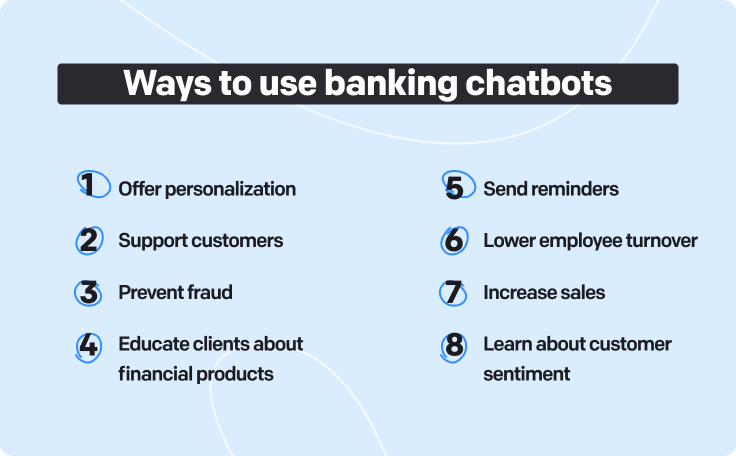
Here are six ways your financial institution can benefit from banking chatbots:
1. Personalize customer interactions
Customer service shouldn't be bland. Each customer is unique. Without personalized customer interactions, your customers could feel like just another number on your roster. That leads to high turnover ratios and a poor brand image.
By personalizing customer interactions, you can meet customer expectations regarding response times and answer quality. With natural language understanding and 24/7 availability, you can meet the demands of a diverse customer base, including night owls and overseas customers.
Additionally, many chatbots have multilingual capabilities. Offering customer service in numerous languages can be a strong competitive advantage, allowing you to attract customers from around the globe.
Chatbots also analyze individual data to offer hyper-personalized guidance, like identifying forgotten subscriptions or suggesting savings plans tailored to a customer's spending habits.
2. Detect and prevent fraud
Fraud plagues the banking sector, with recent studies showing that 35% of companies reported over 1,000 fraud attempts during 2023. Even more telling: 61% of companies reported an increase in fraud attacks on consumer accounts, while 54% of companies reported a rise in business account fraud attempts.
Just one successful fraudulent attack could have serious implications for your brand image and profitability. Banking chatbots help you reduce your risk of fraud by analyzing a customer's spending habits and detecting unusual payments. Any detected outliers are promptly reported to your customer for verification, safeguarding you and your customers.
AI technology in banking chatbots can evaluate customer behavior in real time, flagging suspicious transactions before they're processed. This approach to fraud prevention is faster and more consistent than manual review.
If you're looking for a secure solution, choose one with no or few dependencies. ChatBot processes and hosts data within its own infrastructure, without relying on third-party providers like OpenAI or Google Gemini.
3. Manage high levels of transactions
Growing financial institutions often receive multiple requests at once. Instead of placing these customers in a queue for live customer service agents, you can route their requests through a conversational chatbot.
Conversational chatbots can answer basic questions about balances, transactions, and due dates, eliminating a bottleneck for your live customer service agents. Chatbots handle high volumes of inquiries simultaneously, reducing wait times and allowing faster resolution of customer issues. This helps you meet customer expectations, even during peak periods.
4. Customer education
Financial products can be difficult to understand, especially when trying to find information through mobile banking apps. Chatbots in the banking industry are designed to educate customers about available financial solutions and answer relevant questions.
Educating your customers makes you more likely to position your business as a trusted resource in the banking sector.
For example, let's say a customer asks, "What type of bank accounts can I open?" Your chatbot can break down each account type, from checking to savings account options, helping the customer make the right selection.
5. Cash flow support
Chatbots in the banking industry are practical tools for supporting cash flow. From reminding customers about upcoming payments to decreasing your virtual assistant costs, banking chatbots can improve your bottom-line profitability.
Prioritizing cash flow is especially important as your business scales and takes on more customers. Banking chatbots grow alongside you without restrictions on processing capabilities, allowing you to fully benefit from digital transformation. Chatbots can save users an average of over 5 hours monthly on financial tasks by automating everyday banking tasks like recurring payments and bill tracking.
6. Built-in upsell and cross-sell strategies
Most financial institutions offer a variety of financial products to customers, from different account types and credit cards to personal loans and investment options. Banking chatbots can be customized to include built-in cross-sell and upsell strategies.
For example, your chatbot technology might be programmed to evaluate a customer's spending habits and transaction history to suggest new banking products, like a lower-interest credit card or a short-term personal loan. This type of personalized service turns customer questions into profit-driving opportunities.
Banking chatbot applications
There are numerous chatbot use cases. Let's explore some of the most relevant ones for the banking industry:
1. Conduct essential banking activities
With artificial intelligence banking technology, customers no longer need to wait in long queues to get basic questions answered. Instead, they can receive quick and reliable services instantly with banking chatbots.
Banking chatbots can automate basic tasks, like moving money between bank accounts and paying monthly bills. This allows your customers to fully take advantage of mobile banking.
As customers increasingly want to discuss their financial situations openly, banking chatbots can provide a breakdown of financial activities. This includes spending habits, account balances, and average monthly bills, all accessible through a single conversation.
2. Answer FAQs
Customers shouldn't have to wait hours on the phone to get answers to common questions, including:
A chatbot for the banking industry can answer these customer queries immediately, regardless of the time.
3. Provide customer support
Customer support takes many forms, not just handling issues. A proactive customer support function keeps your customers in the loop at all times. Banking chatbots can send customers notifications about payment reminders, transfer requests, current charges, posted transactions, and credit score updates.
When customers enable push notifications, they no longer need to log in to their account and search for account information. They receive notifications instantly from banking chatbots. This kind of proactive support can also help financial advisors focus on higher-value conversations instead of fielding routine customer inquiries.
4. Identify and resolve suspicious activity
Companies that commit to data security build a brand image of trust and dependency. By having a chatbot working in the background to identify and resolve suspicious activity, you reduce the risk of fraudulent hacks and attacks.
For example, your chatbot can ask customers to verify a suspicious transaction before it's posted. This requires no review from your internal team and allows your business to continue operating without disruptions or time-consuming customer service inquiries. Chatbots can alert customers to suspicious transactions in real time, enabling quick verification and action and significantly improving customer trust and satisfaction with banking services.
5. Facilitate financial product applications
Most financial product applications are conducted online. Your banking chatbot can facilitate the process from start to finish without any human intervention needed.
For example, your chatbot can suggest the best product based on the customer's preferences and guide the customer through each step of the application process. This customized approach builds customer satisfaction and helps with your upsell and cross-sell strategies. Emerging agentic AI capabilities even allow chatbots to autonomously gather documents for loan applications, making the process smoother for both the customer and your team.
6. Promote reviews and feedback
Reviews and feedback are crucial components of building a strong brand image. Banking chatbots make it easy to collect customer feedback, whether good or bad. Short- and long-form surveys can be conducted through your chatbot, enabling you to gather valuable information.
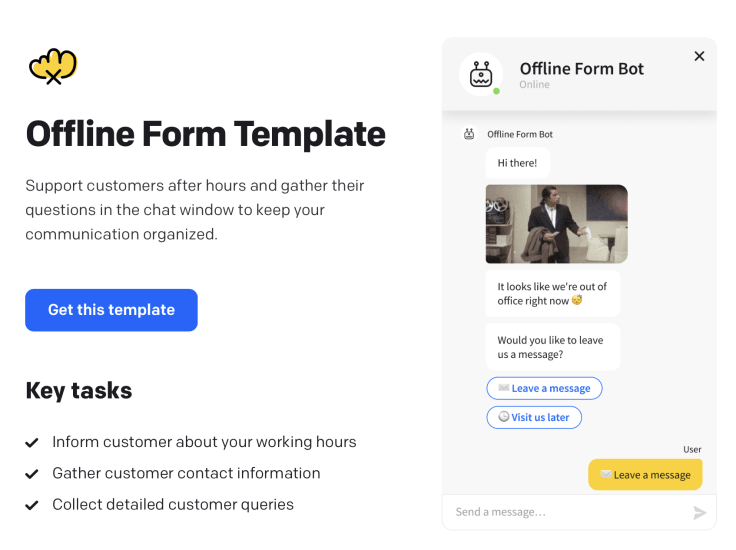
Make sure to try out our offline form template. When enabled on your site, it will inform customers that your team is offline and let them leave messages in the chat window.
The fundamentals of banking chatbots
Effective banking chatbots should include a few core components:
1. Conversational
At the most basic level, your banking chatbot needs to be conversational. Customers should feel like they are communicating with an actual person in terms of syntax, grammar, and punctuation. Without a personal feel, customers get frustrated, which generates a poor customer experience.
The good news is that most chatbots in banking use natural language understanding to simulate human-like conversation. Conversational banking should be a fundamental component built into your chatbot. Advanced natural language processing enables AI chatbots to understand context, tone, and intent rather than just matching keywords.
2. On-brand
Your chatbot is an extension of your company, so its features need to align with your branding. For example, your chatbot should understand your policies regarding late fees, due dates, and other core components.
Without the proper back-end training, your chatbot could distribute inaccurate information, leading to a mismatched brand image and confused customers. Before your banking chatbot goes live, ensure all necessary backend information is up to date and accurate.
3. Transactional
Implementing a banking chatbot should lead to cost savings. After all, you are alleviating a portion of the burden on your live customer support agents. When looking for a banking chatbot, understand the expected cost savings.
- Will you be able to increase profit from cross-selling strategies?
- How about decreasing the costs of outsourced customer service agents?
Set benchmarks for your cost savings and follow up on actual results. If your expected and actual results greatly differ, it might be time to take a deeper dive into the fundamentals of your chatbot and make adjustments. The banking industry has seen significant cost savings from chatbot adoption, with estimates suggesting billions of dollars in annual savings across the sector.
4. Informative
Another core competency your chatbot should have is value. Answers provided by chatbots shouldn't be generic. Instead, they should be customized to fit the specific needs of the inquiry or customer.
Let's say a customer asks about the due date of their credit card bill. If your chatbot gives a generic answer, like "Bill due dates vary based on when your credit card was opened," it's not very helpful. Your chatbot needs to give specific and accurate answers, such as "Your bill is due on May 15." That's the difference between a chatbot that frustrates and one that builds trust.
5. Secure
The customer data and sensitive information transmitted between your chatbot and the customer need to be secure. Sensitive information, such as a customer's address or account number, is often stored in the chatbot.
A fundamental feature to consider is using a chatbot that is not dependent on third-party providers. When all data is processed and hosted within the chatbot platform, you reduce the risk of sensitive customer information leaking to unauthorized parties. Banks also increasingly rely on Explainable AI (XAI) to provide clear reasoning for automated decisions, maintaining consumer trust and compliance with data protection regulations.
6. Integrated
Your chatbot shouldn't default customers to an entirely different portal. Instead, it should be an extension of your mobile app or website, operating seamlessly in the background. Customers who need to use a different platform could be hesitant about the chatbot's authenticity.
Make sure your chatbot is integrated into your business' existing systems. This allows the chatbot to access important systems, such as your customer support database and knowledge base, to provide customers with accurate responses. Chatbots support multimodal access, providing instant support across marketing channels such as mobile apps, websites, and messaging platforms.
7. Analytical
Chatbots need more than just basic question answering. To fully benefit from cross-sell and upsell strategies, your banking chatbot should have an analytical component. It should be able to gather customer information and compile it into reports for your management team to review.
For example, if dozens of customers report the same issue in the mobile app, your development team can swiftly resolve it. The consistent analytical data your chatbot produces can help you build your competitive edge in banking products and services.
8. Continuously improving
Although most chatbots use some form of machine learning, always verify continuous improvement. The data your chatbot produces should be used to further develop your system and provide customers with accurate answers.
Continuous improvement makes your system more efficient and effective over time, strengthening your value proposition to customers. However, make sure the improvements and adjustments the chatbot makes align with your brand image and expectations.
For example, a chatbot could pick up on a customer's lax tone. This might not present your business as an authoritative and trustworthy source. As a result, you may need to adjust your chatbot improvements to realign your goals and strategies.
10 of the best banking chatbots
The popularity of chatbots in banking means you have numerous providers to choose from. When selecting a chatbot provider, keep the fundamentals in mind. You want to choose one that offers the most advantages and scales alongside your business.
Here's a breakdown of top finance chatbots for banks, plus notable in-house solutions built by major financial institutions:
1. ChatBot
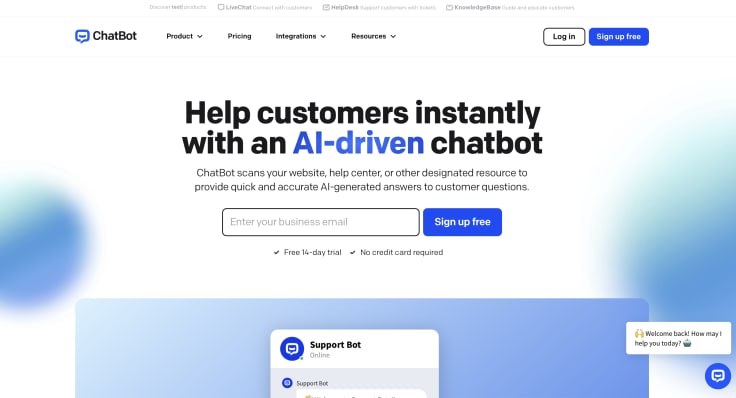
ChatBot makes the list of the best banking chatbots because of its back-end security features. ChatBot processes and hosts data only within its own infrastructure, with no dependencies on third-party providers. It provides 24/7 customer support with quick and accurate AI-generated answers to customer questions specific to the banking industry. And because it connects with live chat and helpdesk tools, banking personnel can see the full picture of every customer interaction.
2. Erica (Bank of America)
Bank of America's Erica is one of the most widely adopted AI-powered virtual financial assistants in the world. Nearly 50 million users have interacted with Erica since its 2018 launch, with over 3 billion total client interactions. Erica helps customers manage account balances, track spending habits, monitor transactions, and receive personalized insights on their finances. More than 98% of users find the information they need without being transferred to a human agent.
3. Eno (Capital One)
Eno is Capital One's conversational AI assistant, available 24/7 to credit card holders. Customers can check account balances, review transactions, get account information, and receive fraud alerts through text-based interaction. Eno also generates virtual card numbers for safer online shopping, a practical security feature.
4. TARS
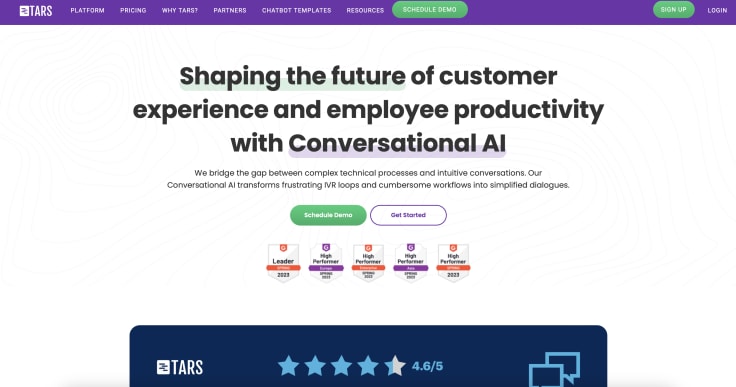
TARS is considered one of the best banking chatbots because of its extensive conversion funnel options. There are hundreds of chatbot templates to choose from, a simple setup process, and different reports to evaluate data.
5. Haptik
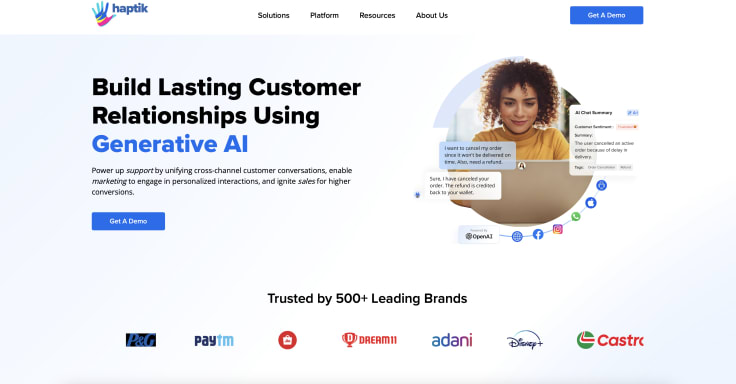
Haptik is a powerful banking chatbot for businesses seeking detailed analytics. This chatbot provider offers comprehensive back-end customer support, which helps improve the customer experience and prioritize customer needs.
6. Kasisto
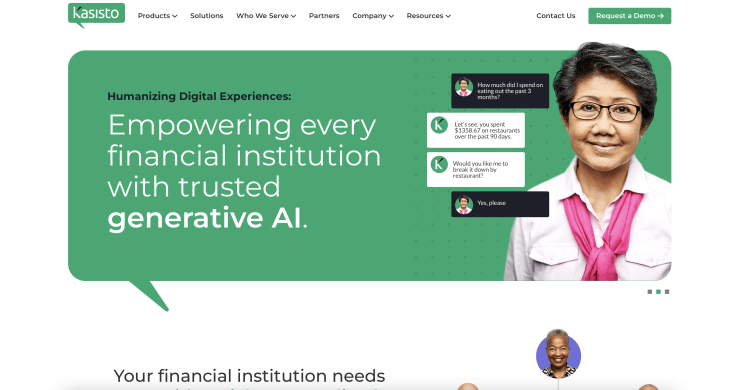
Kasisto uses machine learning to make realistic recommendations to clients, supporting cross-sell and upsell strategies. Kasisto can also answer basic service requests and has multiple channels for communication, including text, touch, and voice commands.
7. Kore.ai

Kore.ai makes the list because of its focus on operational efficiency. This provider offers comprehensive reporting, allowing you to track and analyze customer inquiries. Kore.ai integrates with over 30 third-party applications, allowing you to use a single central system.
8. Ceba (Commonwealth Bank)
Commonwealth Bank's Ceba can assist customers with over 200 everyday banking tasks and is available 24/7. Ceba manages around 60% of incoming contacts end-to-end, without requiring human support, making it one of the most effective virtual agents in the banking sector.
9. NOMI (Royal Bank of Canada)
NOMI from the Royal Bank of Canada offers budgeting, cash flow analysis, and spending insights. Since its introduction, NOMI has delivered over 2 billion personalized insights to customers, making it a standout for personal finance management.
10. Clari (TD Bank)
Clari from TD Bank provides instant responses to common questions about users' accounts and assists with tasks such as money transfers and bill payments. It's a good example of how a banking chatbot can handle routine activities while freeing up human agents for more complex issues.
Banking chatbot implementation best practices
When implementing your banking chatbot, follow a few best practices.
1. Know what your customers want
You could implement the best chatbot on the market, but if it doesn't meet customer expectations, it will have little to no impact on your value proposition and bottom line. Before implementing a chatbot, fully understand what your customers are looking for.
Do they want to track their financial habits? How about 24/7 customer support? Understanding your audience's needs provides a baseline for designing your chatbot's features and fundamentals.
Start by gathering demographic information, including the average age of your customer base, the types of support inquiries you've dealt with in the past, and the main features customers request.
Remember, customer needs can change after implementing your chatbot, so don't be afraid to adjust your value proposition along the way.
2. Align your chatbot with your brand voice
The conversational language a millennial uses differs greatly from that of a baby boomer. If you're a fintech startup looking to attract younger customers, your brand voice should cater to that target market.
Your chatbot should be an extension of your overall brand, following the same principles as your physical locations, website, phone support, and other marketing channels. However, don't make your brand voice too relaxed. Your chatbot should be knowledgeable and authoritative but friendly and approachable.
Before you roll out your new chatbot, test your brand voice by asking questions in different ways. You should be able to understand how your chatbot will handle different customer interactions. Make adjustments if you notice any responses that don't align with your brand voice.
3. Regularly review information
AI chatbots use machine learning to continuously adapt to your target market. This means that your brand voice and processes can begin to shift away from your goals. By regularly reviewing and testing your chatbot, you can catch any shortcomings and make the necessary adjustments.
Regular information review and feedback can also help you pinpoint inefficiencies in your chatbot. Make it a priority to review your chatbot monthly. This process should include analyzing customer feedback, fixing any issues, and confirming that all functions are optimized.
4. Optimize human agents and chatbots
As helpful as banking chatbots can be, they aren't a substitute for human agents. Chatbots collaborate with human agents, escalating to a person when complex judgment or empathy is required. It's crucial to have live agents ready to jump in and assist customers when needed. Before you implement a banking chatbot, understand how you will balance human support and automation.
Will you still have live agents 24/7? Will you reduce live agent hours to normal business hours? Can you reduce the number of customer service agents? These are all important questions to answer before implementing a banking chatbot.
Successful implementation of banking chatbots will optimize your cost savings while still providing customers with the support they need. Take the time to think through how your banking chatbot will alter the dynamic of your customer support function. When the AI agent can't resolve an issue, it hands off to a human agent with full context and conversation history preserved.
5. Prioritize security and compliance
The rise of technology has prompted many regulatory agencies to expand their oversight of consumer information protection. This makes it essential to understand the data protection regulations your business must comply with.
At the most basic level, communication between customers and your chatbot needs to be secure. This might involve having a firewall, a secure server, and a chatbot integrated into your existing systems to minimize unsafe connections.
Additionally, understand how different financial institution security regulations apply to chatbots. What customer data can you store? How can you use the data harvested from customers? These areas are crucial to maintaining regulatory compliance. Banks are now deploying advanced security frameworks, including Zero-Trust Security architectures, biometric defenses, and advanced encryption protocols to keep chatbot interactions safe.
Enable AI chatbots in banking industry
The shift in customer expectations bodes well for the future of chatbots. Whether your organization is considering adding a banking chatbot for the first time or you're looking to switch providers, the question isn't whether to adopt one, but how to make it work hardest for your business.
ChatBot is built for the banking industry. It delivers quick and accurate AI-generated answers to customer questions, requires no coding to set up, and operates independently of third-party providers, keeping sensitive information secure.
If you still have questions about what a banking chatbot looks like for your organization, check out our FAQ section below. Your support team is sitting on opportunities you haven't tapped yet. Give them the right tools and see what happens.
FAQs
How do banking chatbots work?
Banking chatbots use artificial intelligence and machine learning to respond to customer queries. By using natural language processing, the chatbot facilitates a human-like conversation with a customer. More complex chatbots use large language models (LLMs) to analyze patterns between words and predict appropriate responses, while simpler rule-based chatbots rely on decision tree logic or keyword databases.
Unlike human support agents, banking chatbots are available 24/7, allowing customers to bypass long wait times. For any tasks a banking chatbot can't handle, it will refer the customer to a live agent with full conversation context preserved.
What services can banking chatbots offer?
Banking chatbots offer a variety of services designed to fit the needs of both you and your customers. Most chatbots focus on answering basic customer questions like payment due dates, available banking products, and customer spending habits.
Some chatbots extend beyond answering basic questions. They can facilitate loan applications, transfer funds, send money, and even check account balances and transaction history. AI chatbots can also provide personalized insights, like budgeting tips or savings plan suggestions based on individual financial data. Your financial institution's needs will determine which chatbot services are most beneficial.
Are chatbots in banking secure?
Yes, banking chatbots are a secure form of communication for your customers. If you are concerned about data security, use a chatbot that does not rely on third-party providers. This ensures all data is kept in-house and is fully secure from external threats. Many banks also use Explainable AI (XAI) to provide clear reasoning for automated decisions, maintaining consumer trust and compliance.
Can chatbot technology handle complex customer interactions?
Chatbots handle most routine customer interactions well. For any question or request the chatbot can't handle, the customer will be referred to a live agent for additional assistance.
That said, chatbot technology has advanced significantly. AI chatbots now understand context, handle multi-step requests, and learn from past interactions to improve over time. Many customers still prefer human interaction for truly complex issues, and that's fine. The goal is to route simple tasks to the chatbot so human agents can focus on the conversations that matter most.
How does artificial intelligence prevent and detect fraud?
Artificial intelligence uses machine learning to evaluate a customer's spending habits and pick out any suspicious activity. The chatbot will then send a request to the customer to verify the transaction's legitimacy.
If the transaction is fraudulent, the chatbot can freeze the customer's account and bring in a live agent to evaluate the situation. AI-powered fraud detection results in more accuracy and speed when it comes to identifying suspicious activity, significantly improving data security for both the bank and the customer.
How do banking chatbots integrate with existing infrastructure?
Banking chatbots are designed to work seamlessly with your existing banking systems. Full integration is usually required to give the chatbot access to important information, like transaction history, account information, and past support tickets.
Integration with legacy banking systems can be challenging and may require significant investment and expertise. However, many modern chatbot solutions, including ChatBot, offer plug-and-play integrations that simplify the process and reduce the timeline from months to days.