

Showing top 0 results 0 results found
Showing top 0 results 0 results found



More than 2 billion people shop online. Ecommerce businesses have more growth opportunities than ever, but keeping up with customer queries, cart abandonment, and rising expectations across every support channel is a different story.
Every product question is a purchase consideration. Every shipping inquiry signals buying urgency. An ecommerce chatbot doesn't just answer questions. It spots these moments and acts on them, turning customer interactions into sales.
Here's how AI chatbots work in ecommerce, how to put them to use in your online store, and six of the best options available right now.
What is an ecommerce chatbot?
An ecommerce chatbot is an AI-powered tool integrated into online stores, messaging apps, or social media that simulates human conversation to assist shoppers in real time. Ecommerce chatbots are designed to:
- answer customer questions,
- assist with ordering,
- automate sales,
- provide post-purchase support,
- connect customers to human agents.
Customers' conversations with AI chatbots are driven by predefined conditions, events, or triggers that are centered on the customer journey. The AI uses natural language processing to understand customer intent and provide dynamic responses that go well beyond a basic script.
Ecommerce chatbots can assist customers immediately and automatically, allowing your support team to focus on more complex queries that need a human touch.
Picture this: you bought a pair of jeans from an online clothing store but you want to return them. You're not sure how to start the return process, so you open the site's chat widget to get help.
The bot immediately presents several options, including one to return your items. You tap "start a return," and the ecommerce chatbot walks you through the whole process. No wait times. No digging through FAQ pages.
This is just one of the many ways an AI chatbot for ecommerce handles customer support without human intervention.
How to use an ecommerce chatbot
AI chatbots in ecommerce help online retailers improve customer service and drive sales growth. Long customer service wait times turn away would-be buyers who seek answers before clicking on the "buy" button.
Ecommerce chatbots reduce that friction, leading to higher conversions and customer satisfaction.
According to our clients, the best ecommerce chatbot examples show the potential to:
- Increase online ordering by 300%
- Drive 30% more leads
Here's what that looks like in practice.
Answer customer questions
Research shows that 81% of customers prefer to solve problems on their own before contacting support. An ecommerce chatbot satisfies this need without inflating your operational costs.
Ecommerce chatbots offer:
- an employee-like experience with instant responses,
- an easy solution for answering common customer inquiries,
- a cost-effective alternative to scaling human support teams.
Omni-channel support is essential for ecommerce brands. Some leads prefer talking to a person on the phone, while others will leave your store for a competitor's site if you don't have live chat or a chatbot covering key messaging channels.
You can customize your bot to:
- assist with order tracking,
- recommend products based on user behavior,
- offer discount codes,
- log feedback,
- and much more.
An AI-powered chatbot pulls data from up-to-date product catalogs, your knowledge base, and shipping policies to make sure every response is accurate. That accuracy builds trust, and trust drives the buying process forward.
Create a more interactive customer experience
Creating a positive customer experience is a top priority for e-commerce brands. Laggy sites or checkout mistakes lead to higher cart abandonment and a failure to meet expectations that keep climbing year after year.
AI chatbots engage customers during key parts of the customer journey to reduce buyer friction and guide them to the right products or services. They can ask customers if they need help when they've been on a page for a long time with little activity.
Chatbots also work behind the scenes, collecting zero-party data to:
- make suggestions based on the consumer's needs or interests,
- guide the consumer to products that fit their preferences,
- assist during the sales process to increase conversion rates.
These personalized customer experiences don't just feel better for the buyer. They directly impact your bottom line. When implemented correctly, AI chatbots help boost customer engagement, automate repetitive tasks, and drive sales without adding headcount.
Prevent cart abandonment
Cart abandonment rates hover around 70%, costing ecommerce stores billions of dollars in lost sales each year. These consumers spent time on your site and were ready to buy, but something went wrong along the way.
The price point may have been an issue, or it could have been a lack of free shipping, a confusing checkout, or simply a distraction.
Chatbots influence conversion rates by stepping in at key moments in the purchasing process to build trust, answer last-minute questions, and address concerns in real time. They can proactively engage customers with personalized messages and incentives to complete their purchases.
Custom chatbots can nudge consumers to complete checkout in multiple languages, enabling seamless conversations across language barriers. You can even deploy them on messaging platforms like Facebook Messenger and WhatsApp to recover abandoned carts through targeted messaging.
Reducing cart abandonment means capturing profit from leads who are already browsing your store.
Provide post-sale support
The best ecommerce chatbots don't disappear after the purchase. Post-purchase support is what turns one-time buyers into loyal customers. AI chatbots can handle questions about:
- returns,
- refunds,
- shipping and order issues.
They can provide real-time order tracking and delivery notifications, so customers always know where their package is. Bots can even share useful product tips and how-tos, helping customers get more value out of what they bought.
Because chatbots are always on and available, customers get the support they need when it's convenient for them, across any support channel. That kind of consistent communication builds the loyalty that turns into repeat business.
Collect and use customer data
Every chatbot conversation is a source of business data. AI chatbots gather information throughout user interactions and can build complete customer profiles. This data helps you:
- learn what customers actually want,
- spot patterns in customer queries and common pain points,
- recommend products or services that address real needs.
Monitoring metrics like First Contact Resolution (FCR), Customer Satisfaction (CSAT), and chatbot-influenced sales helps you measure ROI and identify knowledge gaps in your bot's training.
(How do you know what's working? Check your chat logs. The answers are usually sitting right there.)
Interactions with chatbots also provide insights into consumer preferences that feed future marketing campaigns and product development. The ecommerce businesses that use this data well don't just support customers better. They sell smarter.
Monitor and improve your chatbots
One advantage of AI chatbots is that they give you a clear picture of how customers interact with your store. You can analyze that data to improve both the bot and the overall customer experience.
The truth is, 40% of web users don't care whether they're being helped by a human or a bot, as long as they get the support they need. What they do care about is speed, accuracy, and consistency.
So, make it a point to monitor your bot's performance. Track key metrics, test different approaches, and iterate. I recommend experimenting with different ecommerce templates to see which ones resonate best with your customers.
Customizing the chatbot's tone and personality helps align it with your brand voice and ensures every interaction feels like a natural extension of your store, not a robotic afterthought. Transparency about interacting with an AI is important too; let users know they're chatting with a bot, and offer a clear path to human agents when needed.
Types of ecommerce chatbots
Not every ecommerce chatbot works the same way. Understanding the differences helps you pick the right fit for your store's needs and your customers' expectations.
AI-powered chatbots use natural language processing and machine learning to understand customer intent and generate responses based on context and behavior. They handle complex queries, learn over time, and provide personalized support that feels like a real conversation. Most modern ecommerce chatbots fall into this category.
Rule-based chatbots operate on predefined scripts and decision trees. They're reliable for handling frequently asked questions and basic customer service requests, but they lack flexibility when conversations go off-script. They work best as a starting point for businesses with straightforward support needs.
Hybrid chatbots combine both approaches. They handle basic queries through rules while passing complex customer interactions to AI or to human agents. This is a practical setup for teams that want automation without sacrificing service quality on tough issues.
Transactional chatbots focus on specific commercial actions: order tracking, checkout assistance, and payment processing. They're built for speed and efficiency in the buying process.
Messaging-focused chatbots are designed primarily for messaging apps like WhatsApp and Facebook Messenger. If your customers already live in these channels, meeting them there with a chatbot is the shortest path to engagement.
Real-world ecommerce chatbot results
Before we get into specific tools, it helps to see what's actually possible. These aren't hypothetical scenarios. They're real numbers from real brands.
Virgin Media O2 built a conversational selling approach where bots start every customer interaction, identify intent, and route sales conversations to the right human or agent-facing bot. The result: 1 in 5 of their sales are now conversational. Their agent-facing bots also reduced handling time by 13.5% while further increasing sales.
Signet Jewelers, the world's largest retailer of diamond jewelry, uses AI to power personalized online shopping conversations. Their approach to orchestrating data and providing tailored, near-instant responses earned them a 90% customer satisfaction score.
Open Universities Australia automated lead generation and qualification with an AI chatbot, achieving 250% ROI. When they upgraded to generative AI agents, their lead qualification rates doubled compared to traditional automation.
Aramark's "Brew to You" trial at U.S. sporting venues let fans scan a QR code and order drinks through an AI chatbot on Apple Messages for Business, with payment via Apple Pay and delivery straight to their seats. It's a perfect example of how automated commerce drives additional profit through pure convenience.
These results didn't come from the chatbot alone. They came from choosing the right tool, feeding it the right data, and integrating it into a broader customer communication strategy.
6 best ecommerce chatbots to boost your business in 2026
Customer queries take up a lot of support time and resources. Resolving questions fast with the help of an ecommerce chatbot will drive more leads, cut costs, and free up your support teams to focus on higher-value conversations.
The best ecommerce chatbots help businesses:
- reduce support costs by 30%,
- resolve 35% of customer queries or complaints automatically,
- offer 24/7 support to customers across messaging channels.
Add an AI chatbot to your ecommerce platform, and you can resolve up to 80% of routine questions. Here are six tools worth considering.
1. ChatBot
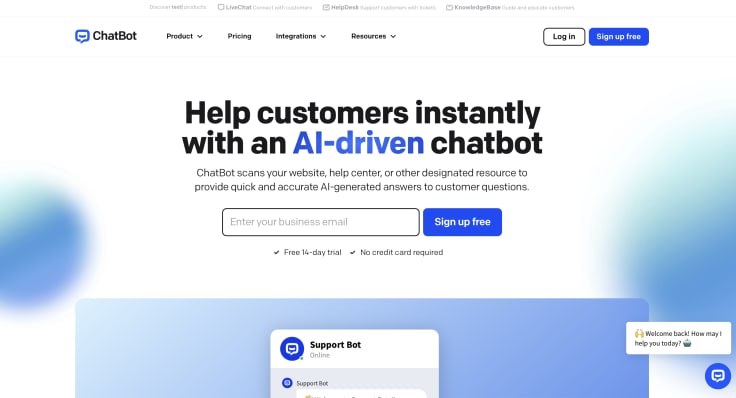
ChatBot is an AI agent trained on your business data. It handles customer questions, recommends products, and resolves issues automatically, all without relying on third-party AI providers like OpenAI or Google Gemini.
Businesses get an ecommerce chatbot that requires no coding to set up, delivers quick and accurate responses, and keeps your data in-house.
ChatBot integrates seamlessly into Shopify to showcase offerings, reduce product search time, and show order status, among many other features. When the AI can't resolve an issue, it hands off to a human agent in LiveChat with full context preserved.
Main features
- Drag-and-drop visual builder to create your ecommerce chatbot stories with zero coding required.
- In-platform testing tool to test your bot before pushing it live.
- Free chat widget that follows your brand's style in a few clicks.
- Prebuilt chatbot templates to launch, customize, and reuse stories.
- Real-time analytics and reports to monitor customer interactions and learn which stories perform best.
- Data collection through the bot to create personalized customer experiences.
- Seamless integration with messaging platforms already in the customer journey: Messenger, LiveChat, Slack, Shopify, and more.
- Open API to create custom solutions for ecommerce businesses.
ChatBot hits all customer touchpoints, and the AI resolves up to 80% of queries.
2. HubSpot Chatbot Builder
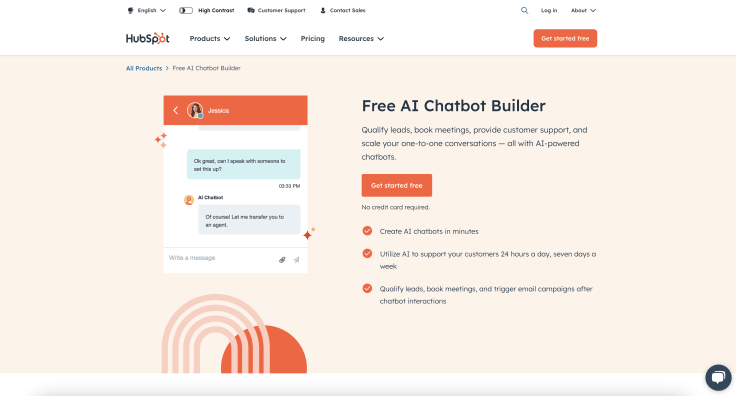
HubSpot offers an easy-to-use chatbot builder that works for websites and Facebook Messenger.
Beyond answering customer inquiries, HubSpot's chatbots can route conversations to live agents, qualify leads, and trigger personalized email sequences when prospects convert.
Features
- Integrate the platform into your CRM to deliver personalized messages using details from your contact list.
- Pull information from your knowledge base or publicly available URLs, like product pages.
- No-code editor with rule-based chat flows.
- Automatically capture lead information and add it to your database.
- Let customers select between pre-defined customized answers.
Pros
- Bot-to-live agent handoff.
- No coding required.
- Quick deployment.
Cons
- Extra features locked behind HubSpot's paid packages.
- Only available for websites and Facebook Messenger.
- Limited chat flow templates included.
3. Chatfuel
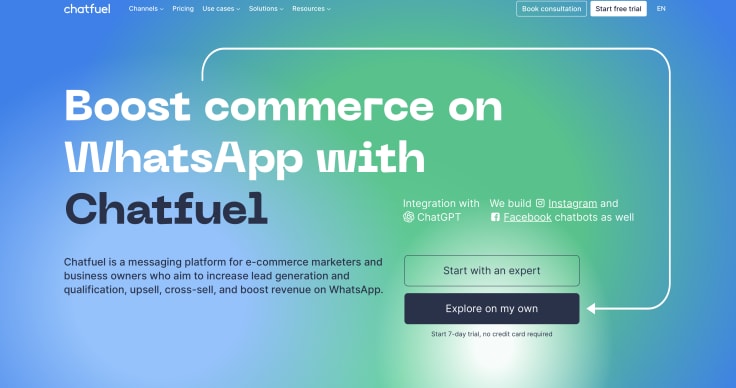
Chatfuel focuses on ecommerce bots for Facebook, Instagram, and WhatsApp. Brands can connect the platform to their websites by integrating Messenger into them.
As one of the best ecommerce chatbot options for handling customer queries on social media, Chatfuel's features include:
- Drag-and-drop builder with no coding required.
- 30+ ready-made templates you can use for free.
- Automatic funneling from direct messages or ads into your communication channels.
- Built-in CRM to segment and qualify leads.
- Integration with Shopify, Google Sheets, Zapier, and more.
Pros
- 99.99% uptime guarantee.
- 24/7 support with 5-minute response times.
- Integration with ChatGPT, Google Sheets, Stripe, and Zapier.
- Re-engage customers using chat history.
Cons
- Third-party integration with ChatGPT makes the ecommerce chatbot reliant on another service provider for its WhatsApp features.
- Slower to release features and integrations compared to some competitors.
4. Tidio
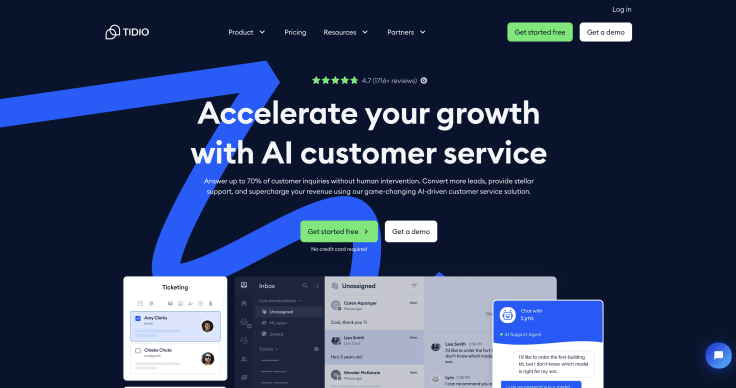
Tidio is an AI chatbot that combines automated support with human agents to solve customer problems. This AI chatbot for ecommerce uses Lyro AI for more natural, human-like conversations.
Tidio can answer customer questions and resolve issues, but it can also track visitors across your site, allowing you to create personalized offers based on their activities.
Features
- Dozens of pre-made templates.
- Custom greetings for new and returning customers.
- Manage live chat, Messenger, WhatsApp, email, and Instagram conversations in one place.
- Visual chat builder with a user-friendly interface.
- Send data to your other platforms from the chatbot.
- Analytics that tracks key metrics.
- Order management and ticketing.
Pros
- Simple installation.
- Visual builder eliminates the need for coding knowledge.
- Bot-to-human handoff.
Cons
- Lacks arithmetic support.
- Limited options for assigning chats.
- Templates can be tricky to navigate.
5. ManyChat
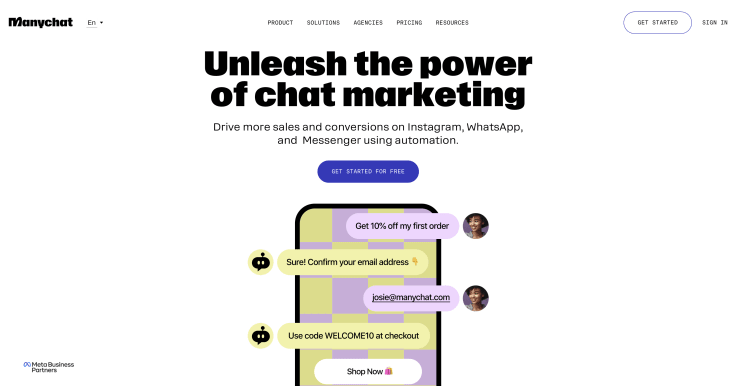
ManyChat is a rules-based ecommerce chatbot with solid features and pre-made templates to get you up and running fast.
Ecommerce businesses use ManyChat to redirect leads from ads to messenger bots. You can also use your bot to automate comment replies on Facebook.
ManyChat's chatbots move leads through the customer journey by sharing sales and promotions, helping leads browse products, and supporting the buying process. Post-sale, it helps with returns and shipping information.
The bot-to-human feature ensures users can reach your sales team for support. There's also an AI Assistant to help with flow creation and messaging.
ManyChat works with Instagram, WhatsApp, SMS, and Facebook Messenger, and integrates with HubSpot, MailChimp, Google Sheets, and more.
Features
- Launch new products, upsell customers, and get reviews directly on Messenger.
- Run giveaways, quizzes, and challenges.
- Let customers browse products or learn about sales.
- Post-sale support for returns.
- Bot-to-human function.
- ManyChat Analytics to track key metrics.
Pros
- Provide instant responses to buyers on social media platforms.
- Customers can purchase from Messenger or your own site.
- Personalized experiences and offers.
Cons
- Missing some advanced features found in other ecommerce chatbots.
- Limited integrations.
- Customer segmentation is lacking.
6. Intercom
Intercom blends AI chatbots with live chat and a full customer messaging platform. Its AI agent, Fin, can resolve customer inquiries by pulling answers directly from your knowledge base, help center articles, and past conversations.
Intercom is a strong choice for mid-size to large ecommerce businesses that need both automated support and a smooth handoff to human agents when conversations get complex.
Features
- AI agent (Fin) trained on your help center content for accurate, context-aware responses.
- Smart triage that routes conversations to the right team based on topic and urgency.
- Deep knowledge base integration for self-serve support.
- Proactive messaging to engage customers based on user behavior and page activity.
- Multi-channel support across web, mobile, email, and social.
- Workflow automation for repetitive tasks like ticket tagging and assignment.
Pros
- Strong conversational AI that improves with every interaction.
- Seamless integration with Shopify, Stripe, and major CRM tools.
- Detailed analytics on customer engagement, resolution time, and team performance.
Cons
- Pricing scales quickly, especially for smaller teams.
- The full feature set has a steeper learning curve.
- Best suited for businesses already investing in a broader customer communication stack.
How to choose the right ecommerce chatbot
Picking the right ecommerce chatbot isn't about features alone. It's about fit. Here's what to weigh when you're making the call.
Integration capabilities should be your first consideration. Your chatbot needs to connect with your ecommerce platform (Shopify, WooCommerce, BigCommerce), your CRM, and the messaging platforms your customers already use. Without seamless integration, even the best AI agent is working blind.
Think about your support volume and complexity. If most of your customer requests are straightforward (order status, return policies, product questions), a simpler chatbot with strong automation will serve you well. If your store deals with custom configurations, B2B quote requests, or advanced inventory management across multiple storefronts, you need something with more depth.
Budget matters, but so does ROI. The cheapest option isn't always the most cost-effective. A chatbot that costs more but handles 80% of customer queries without human intervention could cut your operational costs significantly and free your support teams for the conversations that close deals.
Scalability keeps you covered. Your chatbot should handle your current support volume and grow with you. Black Friday traffic spikes, international expansion, adding new messaging channels: your tool should handle all of it without breaking.
Customization defines your brand experience. A chatbot that matches your brand voice and personality feels like a natural part of your online store, not a generic add-on. The ability to set tone, behavioral limits, and conversation style ensures consistent communication across every customer touchpoint.
When choosing, run a trial. Most platforms offer one. Test with real customer scenarios, measure how the bot handles actual queries, and pay attention to where it succeeds and where it needs a human.
Turn customer conversations into sales
Online stores must deliver a strong customer experience. 49% of consumers have stopped shopping at a brand due to a bad experience. Resolving customer inquiries fast and providing personalized support is easier with an AI chatbot than by scaling internal teams.
An ecommerce chatbot reduces response times, handles customer support around the clock, and gives your human agents the space to focus on conversations that require empathy, judgment, or a personal touch.
You can integrate the ecommerce chatbots above into your website, social media channels, and even your Shopify store. Deploy them across the messaging platforms your customers already use, and you're meeting people where they are, not forcing them to come to you.
The best part? Every customer interaction becomes a data point, and every data point makes the next interaction better.
Your support team talks to more prospects in a week than your sales team sees in a month. Give them the tools to turn those conversations into profit.