

Showing top 0 results 0 results found
Showing top 0 results 0 results found



TL;DR
- A retail chatbot is an AI-powered assistant that handles product questions, order status, returns, and recommendations directly in chat, typically on a website, in Shopify, or inside Messenger/WhatsApp.
- The highest-ROI use cases are post-purchase (order tracking, returns, delivery updates) and pre-purchase guidance (sizing, product discovery, gift recommendations).
- Modern retail chatbots aren't FAQ widgets. They're "AI Agents" that pull live data from your catalog and order systems, and take actions (start a return, recommend products, route to a human).
- For Shopify merchants, the AI Agent in Text ships with a Sales Advisor skill that searches your product catalog natively.
- The vendor landscape has shifted significantly since 2024. Drift was acquired by Salesloft and is being sunset in 2026, and the most relevant platforms now are Shopify-native or omnichannel-firs
What is a retail chatbot?
A retail chatbot is an artificial intelligence tool used in the retail industry to improve customer service by helping shoppers complete tasks they used to need a human agent for. Modern chatbots in retail handle customer inquiries, interpret customer queries with natural language processing, pull live data from product catalogs and order systems, and take actions like checking inventory, generating return labels, or recommending products. For a deeper look at how Text approaches the retail vertical specifically, see our AI chatbot solution for retail.
The category has changed substantially in the last two years. The 2022-era retail chatbot was largely a scripted decision tree, useful for FAQs and limited beyond that. The 2026-era retail chatbot is closer to an AI Agent: a system that retrieves grounded answers from your store data, chains multiple steps together to resolve an entire shopper request in one conversation, and can support support, sales, and marketing teams at small to mid-sized retail businesses.
That shift matters because the same shopper questions ("Is this in stock near me?", "Will this fit?", "Where's my order?") now directly affect conversion, cart abandonment, and support volume. This guide explains what a retail chatbot is, where it works best, how AI Agents handle product discovery, sizing, order tracking, and returns, which platforms to compare, and how the right bot can assist customers across an online store and physical stores.
12 use cases for retail chatbots
These are the 12 workflows that show up most often in retail chatbot deployments today, ordered roughly by how much revenue they move.
1. Product discovery and recommendations
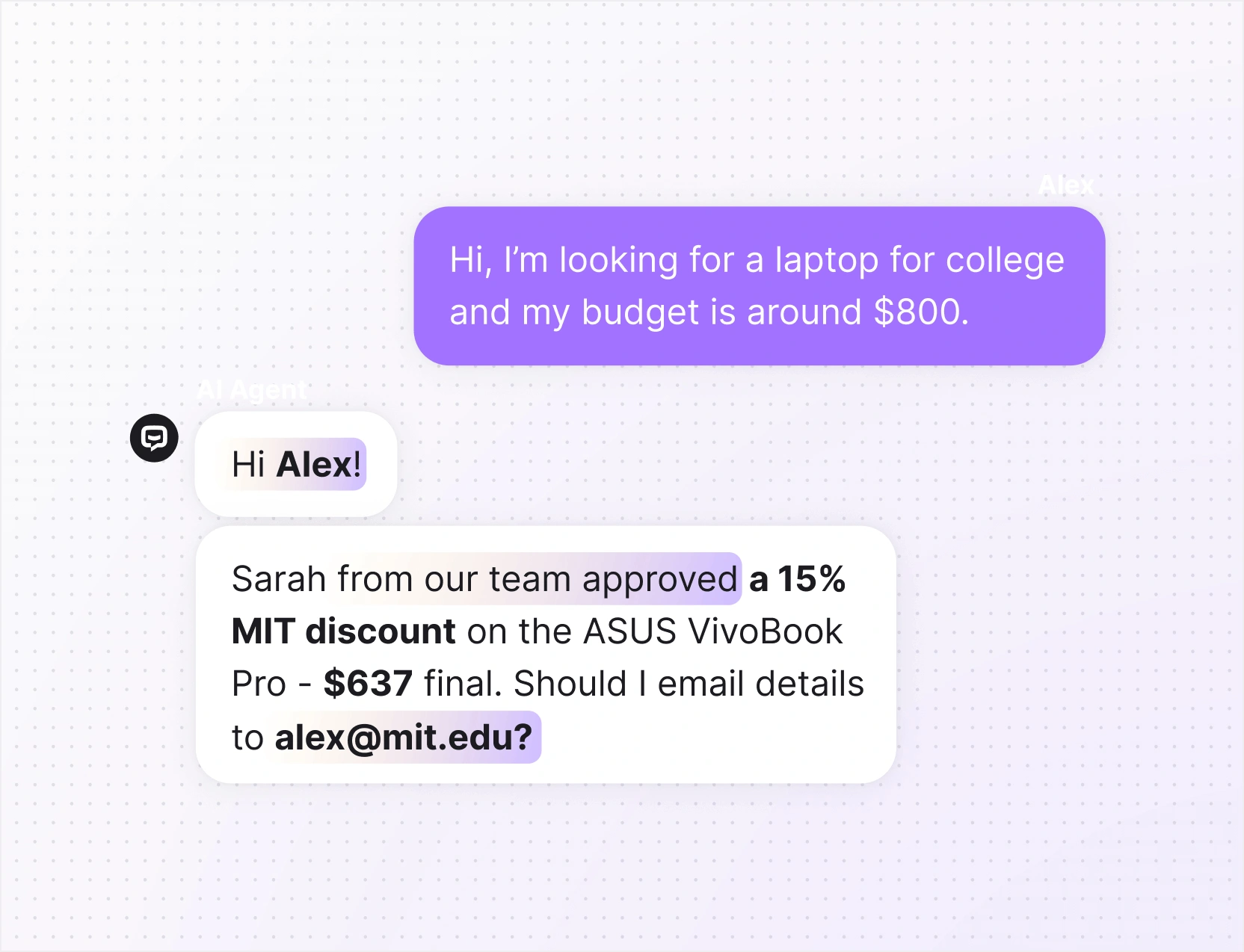
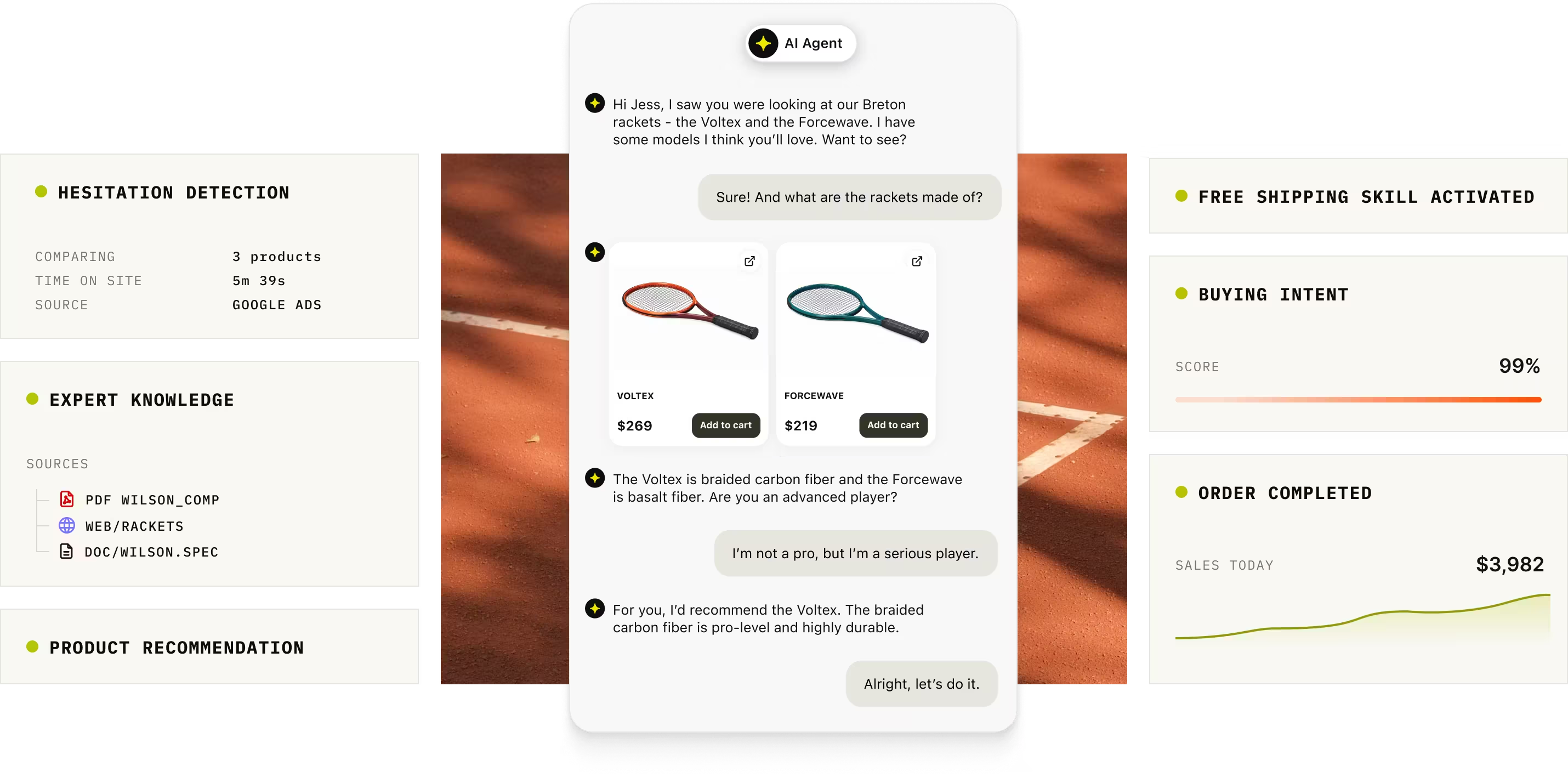
A shopper lands on the homepage and asks, "I need a gift under $80 for someone who loves espresso." A modern retail chatbot does what a good store associate would: asks one or two clarifying questions, then returns a short shortlist with photos, prices, and direct add-to-cart links, including personalized product suggestions based on customer preferences and purchase history. The AI Agent in Text does this natively for Shopify merchants: it searches the live product catalog and surfaces matching items inside the chat. For ecommerce-specific guidance, see our AI chatbot for ecommerce solution.
The conversion lift here comes from removing the "browse 40 categories" step. A shopper with a specific intent gets a relevant shortlist in 15 seconds. These personalized suggestions enhance the customer experience, help improve customer satisfaction, support driving sales, and can lift average order values.

2. Order status and "Where's my order?" (WISMO)
WISMO queries are one of the most common customer support workflows that retail bots automate in retail. A chatbot connected to your order management system answers these in seconds, pulling shipment status, ETA, and tracking links from the conversation itself.
AI chatbots can automate 125,000 chats per year by handling routine customer interactions with instant answers and instant support, and leading deployments reach 93% satisfaction for customer support.
According to Narvar's 2024 State of Returns research, post-purchase queries make up the majority of contact volume for most online retailers, which makes this the fastest ROI use case in the entire list.

3. Returns and exchanges
A shopper types "I need to return my sneakers." The chatbot verifies the order, confirms eligibility against your return policy, generates a label, and explains the refund timeline. That helps streamline customer support, reduce customer support costs, and ease the load on customer service agents by automating standard return requests. No tickets, no waiting, no escalation needed for the 80% of returns that follow standard rules.
This is the second-highest-volume retail workflow after WISMO, and one of the highest-impact for cost reduction.
4. Sizing, fit, and compatibility questions
"Is this true-to-size?" "Will this case fit iPhone 15 Pro Max?" "Does this work with my older model?" These are conversion-killers when the shopper can't get an answer. A chatbot that's read your product specs and customer reviews can act like one of your virtual shopping assistants, helping enhance customer experience throughout the shopping journey with instant answers.
This use case is especially valuable for apparel, footwear, and electronics, where sizing or compatibility doubt drives most cart abandonment. Fast answers to fit and compatibility questions address specific customer needs and help improve customer satisfaction.
5. In-store inventory and store locator
For omnichannel retailers, a chatbot connected to live inventory and integrated with inventory management systems lets shoppers ask "Is the black hoodie size large in stock near me?" and get a real answer, plus a reserve-in-store link if your fulfillment supports it. It can also support broader inventory management workflows so customers can check product availability and store hours without waiting on staff.
By talking to a virtual assistant, customers can locate nearby stores, check stock in the closest location, and get multilingual answers when international customers ask about availability or where to shop.
6. Cart recovery and checkout assistance
Cart abandonment is a $260B+ problem in global ecommerce. A chatbot that can engage customers at checkout can recover a meaningful share of those carts by answering shipping questions, applying available promo codes, and using personalized suggestions to reduce hesitation. Our 2026 chatbot statistics roundup tracks the conversion lift across the category, with ecommerce chatbots cutting cart abandonment by 20-30% while also supporting repeat purchases.
This works best when paired with LiveChat for the high-value carts that need a human nudge.
7. Customer education and FAQs
24/7 access to information about products, return policies, promotional campaigns, and discount coupons. By automating FAQ responses, the chatbot improves customer service and helps retailers deliver exceptional customer service at scale, while freeing your team for the conversations that actually need them.
The FAQ ChatBot template automates answers to common support questions and links customers to detailed articles when they want to dig deeper.
8. Loyalty program management
Members can check point balances, unlock tier rewards, or redeem perks without leaving chat, making loyalty programs a practical customer engagement tool. Because everything flows through the same conversation interface, loyalty members get a frictionless experience while retailers focus on enhancing customer engagement and encouraging repeat purchases through rewards interactions in chat.
9. Personalized notifications and promotions
Want to notify customers about new products or discounts when they've disabled browser notifications? Send updates through chatbot conversation on your site and across social media platforms. The discount template handles seasonal promotions and newsletter signups in one flow, which retail brands use to engage customers with tailored offers.
10. Live agent support
Even with a strong chatbot, some conversations need a human. The best retail chatbots act as a triage layer for retail companies, answering what they can to streamline support, then handing off to a live agent in LiveChat with full context preserved. The shopper never has to repeat themselves.
The bot also serves as a real-time knowledge base for your live agents, surfacing answers during customer queries so reps can handle policies, product specs, or order details without leaving the conversation and improve customer interactions.
11. Customer feedback and CSAT
A chatbot can ask for ratings and feedback at the end of every chat or order to capture customer satisfaction scores. The customer satisfaction widget lets shoppers rate the experience and leave comments, giving your CX team a continuous signal stream. Strong retail chatbot deployments also report a 93% satisfaction rate, which gives teams a useful benchmark.
12. Sentiment analysis and conversation insights
Modern retail chatbots use NLP to analyze every conversation, surfacing patterns from customer data and real customer data gathered in chats ("20% of all chats are sizing questions on this SKU") that point to PDP improvements, missing policy pages, or product issues. Teams can analyze customer data to spot patterns and improve retail solutions over time, turning the chatbot from a support tool into a continuous product research channel.
How retail chatbots actually work
Retail chatbots fall into three categories, and in retail AI the difference between them is mostly about what they can pull data from, not how they look in the widget.
Rule-based chatbots follow a pre-built decision tree. They're useful for fixed-answer questions ("What's your return policy?") and they're the easiest to deploy, but they break the moment a shopper asks something off-script.
AI-powered chatbots use NLP and LLMs to interpret intent and respond conversationally. In ai powered retail, they can answer questions the rules didn't anticipate, but if they aren't grounded in your store data, they'll occasionally make things up. Confident misinformation about pricing or availability is the fastest way to lose a sale.
AI Agents are the current frontier. They combine the natural-language interface of a retail AI chatbot with structured access to your catalog, orders, and policies, so they don't just talk, they act. MCP can connect these workflows to store systems without complex backend dependencies. The AI Agent in Text, for example, can search a Shopify catalog, surface product cards, and recommend items based on what the shopper described, all without human handoff for the routine cases. For a deeper dive into how AI agents work specifically in online stores, see our guide to AI agents for ecommerce.
The right type for your store depends mostly on your catalog size and how much of your support is post-purchase versus pre-purchase. Heavy WISMO volume needs real order-system integration. Heavy discovery questions need real catalog access. A static FAQ bot can do neither.
Best retail chatbot platforms in 2026
The retail chatbot category has gone through a wave of consolidation since 2024. Drift was acquired by Salesloft and is being sunset, AlphaChat was absorbed by Zurich Insurance, and several smaller platforms have effectively gone dormant. Here are the platforms still actively serving retail and ecommerce merchants in 2026.
A quick note on naming before we get into the list: ChatBot is part of Text, the customer service platform formerly known as LiveChat. Text consolidates ChatBot, LiveChat, HelpDesk, and KnowledgeBase into one workspace, so when you sign up for ChatBot, you're plugging into a broader stack that includes live chat handoff and AI Agent capabilities. That matters for retailers who want one platform for chat, automation, and support tickets rather than stitching together several tools.
Comparison table
|
Platform |
Best for |
Channels |
Pricing |
|---|---|---|---|
|
ChatBot |
Mid-market to enterprise retail, omnichannel |
Web, Shopify, Messenger, Slack, WordPress, LiveChat |
From $52/mo, 14-day free trial |
|
Tidio |
SMB ecommerce, Shopify |
Web, Messenger, Instagram, WhatsApp |
Freemium; Lyro AI from $39/mo |
|
Octane AI |
Shopify Plus brands, quiz-led commerce |
Shopify, Messenger, SMS |
From $50/mo |
|
Manychat |
Social commerce, Instagram-first brands |
Instagram, Messenger, WhatsApp, SMS |
Free tier; paid from $15/mo |
|
Chatfuel |
Messenger and WhatsApp automation |
Messenger, Instagram, WhatsApp |
Free start; paid from ~$14.99/mo |
|
Gorgias |
Shopify support helpdesk with chatbot |
Web, Messenger, Instagram, email |
From $10/mo |
ChatBot
ChatBot is the AI chatbot product in the Text suite, built for retailers who want one platform for AI-powered chat across their website, Shopify store, and messaging apps. It stands out among retail industry chatbots as one of the broader retail chatbot development options for brands that want omnichannel deployment. Because ChatBot ships alongside LiveChat, HelpDesk, and KnowledgeBase inside Text, you get chat automation, live agent handoff, and ticketing in one workspace rather than three separate vendors. Its no-code drag-and-drop builder lets non-developers create chatbot flows in minutes, and pre-built templates cover the most common retail use cases out of the box.
What sets it apart for retail: the AI Agent ships with a Sales Advisor skill that connects to your Shopify product catalog and surfaces relevant products inside the chat. When the bot reaches the limit of what it can answer, it hands off to a human agent in LiveChat with full conversation context preserved, so the shopper never has to repeat themselves. If your broader stack supports it, those touchpoints can also extend into mobile apps for a more consistent support experience.
It also supports the post-purchase side: order status lookups, return flows, and live order tracking integrate cleanly with Shopify, WordPress, and WooCommerce. That helps a retail business improve customer support across channels while keeping service workflows in one place. For retail-specific deployment, see the retail chatbot solution and the ecommerce chatbot solution.
ChatBot scales from small online stores to large enterprise retailers, with multilingual support for global teams. The ecommerce template covers special offers, cart additions, order processing, and 24/7 support in one ready-to-deploy flow.
Tidio
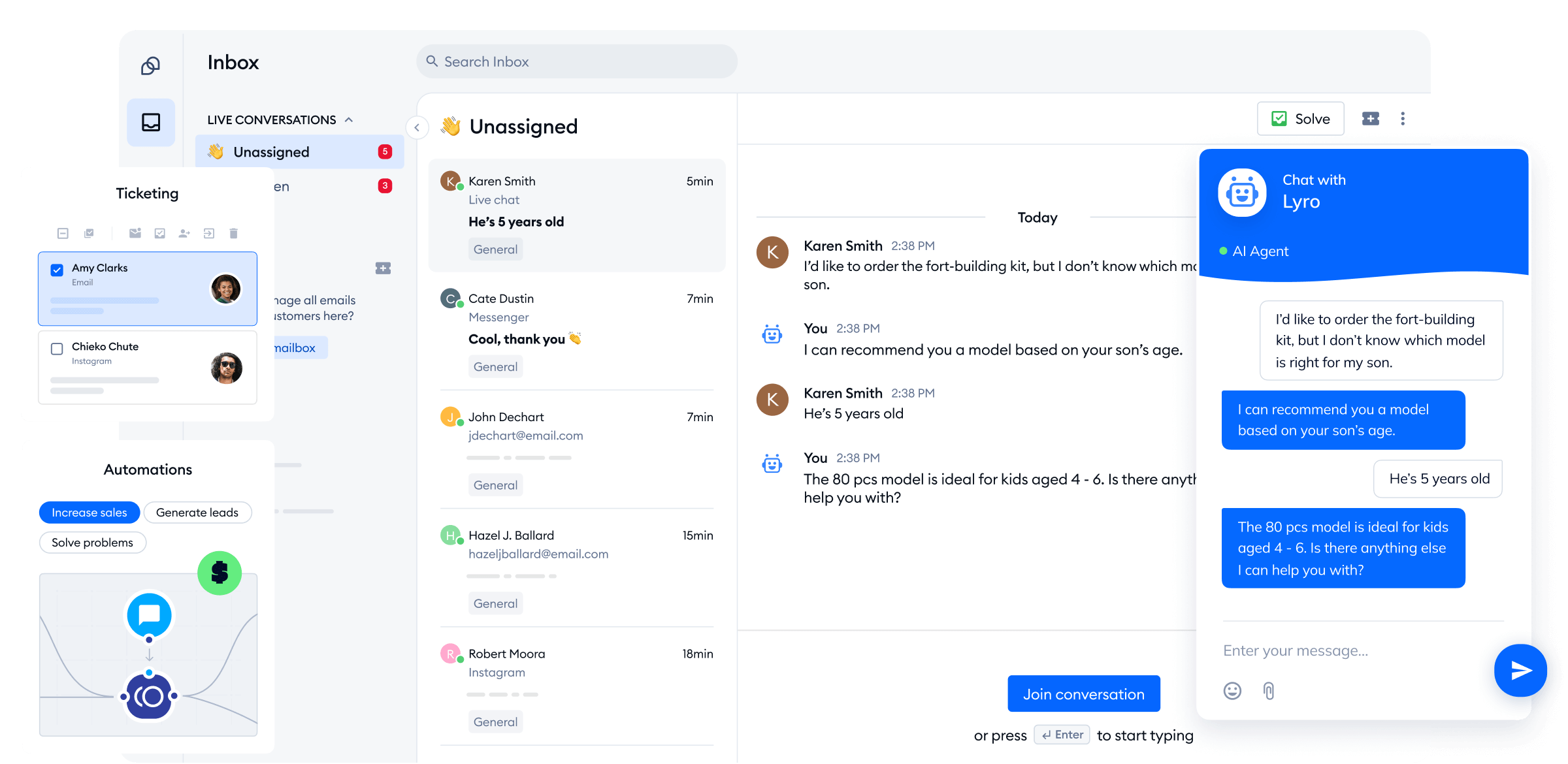
Tidio targets small and mid-market ecommerce stores running on Shopify. Its Lyro AI assistant uses your knowledge base to answer free-form support questions.
A fit if you want freemium-friendly pricing and a fast Shopify deployment. Lighter on enterprise omnichannel features and on the live-agent handoff layer than ChatBot.
Octane AI
Octane AI is a Shopify Plus platform built around quiz-driven product discovery. The flagship use case is zero-party data collection: a shopper takes a guided quiz, the platform records their preferences, and that data feeds email, SMS, and on-site messaging.
A fit for beauty, supplements, and apparel brands where guided discovery drives most of the conversion. Not a fit if your priority is post-purchase support or general customer service automation.

Manychat

Manychat is a social-commerce automation platform focused on Instagram and Facebook Messenger... Not built for website-first stores or omnichannel support, where a platform like ChatBot is the cleaner choice."
It integrates with Shopify and Stripe for in-chat checkout. Less suited to website-first stores, where ChatBot or Tidio fit better
Chatfuel

Chatfuel is another Meta-channel automation platform covering Messenger, Instagram, and WhatsApp. Like Manychat, it's built for social-first retailers rather than website-first stores. Paid tiers include GPT-5 access.
The platform supports WhatsApp Business API across all paid plans, which can matter in markets where WhatsApp is the dominant messaging channel (LATAM, Southeast Asia, parts of Europe). Same limitation as Manychat: it covers social channels well, but doesn't replace a website or omnichannel chatbot.
Gorgias

Gorgias is a Shopify-native helpdesk with chatbot automation built in. For retailers whose primary pain is ticket volume across email, chat, and social, it bundles those channels into one inbox with auto-resolution on top.
A fit if you're consolidating helpdesk tooling and you live in Shopify. Not built as a dedicated AI Agent layer for product discovery or sales-led conversations, where ChatBot's Sales Advisor skill goes deeper.
Choosing the right platform
The best platform depends on what your retail business in the retail sector actually needs. A few practical rules from teams that have deployed retail chatbots well:
- If most of your contact volume is post-purchase (order status, returns, delivery questions, and customer inquiries), prioritize platforms with deep order-system integration. ChatBot and Gorgias are strong here.
- If most of your contact volume is pre-purchase (product discovery, sizing, recommendations), prioritize platforms with real catalog access and personalized suggestions through customer data. ChatBot's Sales Advisor skill and Tidio's Lyro both pull from live product data.
- If your traffic is primarily social (Instagram, Messenger, WhatsApp), Manychat or Chatfuel will beat any web-first platform on those channels.
- If you're on Shopify and want one tool for chat, email, and support tickets, Gorgias or ChatBot with the LiveChat + HelpDesk stack are the two cleanest options.
The conversion-killer to avoid: deploying a chatbot that confidently makes things up about price, availability, or promo rules. Always test the bot's grounding before going live, and keep a clean escalation path to a human for anything emotional, sensitive, or high-value.
Pick the chatbot that matches your store
Retail chatbots have moved from FAQ widgets to retail bots that improve customer service and enhance the customer experience. The best ones handle routine questions instantly, assist customers with instant support across channels, recover carts that would otherwise be lost, and free your team to focus on the conversations that need a human.
If you're running on Shopify, WordPress, or a custom storefront and you want one platform that handles AI-powered chat, live chat escalation, and the AI Agent sales advisory layer, ChatBot is worth a serious look. Set up an account, plug in the ecommerce template, and you can have a working retail chatbot live in under an hour.
If you're specifically focused on pure ecommerce rather than omnichannel retail, our companion guide to the best ecommerce chatbots covers Signet Jewelers, Open Universities Australia, and other verified deployments worth a look.
Start a free ChatBot trial. 14 days, no credit card required.
FAQ
What is a retail chatbot example?
A retail chatbot example is any AI-powered conversational assistant deployed by an online or omnichannel retailer to handle shopper questions. The most common examples are post-purchase ("Where's my order?", "I need to return this") and pre-purchase ("Help me find a gift under $80," "Is this in stock near me?"). Modern retail chatbots connect to live product catalogs and order systems so they can answer with real data, not canned responses.
Do retail chatbots actually increase sales?
Yes, when they're set up correctly. The biggest sales lift comes from removing friction at decision points: answering sizing or compatibility questions before the shopper bounces, recovering abandoned carts, and surfacing relevant products to shoppers who would otherwise leave without buying, while personalized recommendations can also improve customer satisfaction. Industry benchmarks suggest well-deployed retail chatbots can lift conversion by 10-30% on the flows they directly serve.
Which retail chatbot is best for Shopify?
For Shopify merchants, the strongest options are ChatBot (with the AI Agent Sales Advisor skill that pulls from your product catalog, see the ecommerce chatbot solution), Tidio (with Lyro AI), and Gorgias (for Shopify-native helpdesk). Octane AI is the strongest fit for Shopify Plus brands with a quiz-led discovery strategy.
Which retail chatbot is best for Instagram and Messenger?
Manychat is the market leader for Instagram automation, with Chatfuel as a close second. Both handle Messenger and WhatsApp as well. Pick Manychat if your priority is Instagram comment-to-DM funnels and you want the larger community of templates. Pick Chatfuel if you want built-in GPT-5 across plans and slightly cheaper entry pricing.
Can a retail chatbot replace human customer service?
No. The best retail chatbot setups pair the bot with human agents: the bot handles the high-volume, low-ambiguity questions (order status, return labels, sizing) and hands off to a human for anything emotional, sensitive, or judgment-dependent. Leading deployments automate about 125,000 chats annually while maintaining 93% resolution rates. Trying to fully automate retail support usually backfires. The cases that need a human are the ones that determine whether a customer comes back.
How long does it take to deploy a retail chatbot?
With a no-code platform and pre-built templates, you can have a working retail chatbot live in under an hour for basic use cases (FAQ, order status, product discovery). Connecting to a Shopify catalog adds another 10-15 minutes. A custom-built bot with deep workflow automation typically takes 2-4 weeks to deploy properly, including the testing, training, and retail chatbot development needed to ground it in your real data.
What about AI Agents vs traditional chatbots?
An AI Agent is the next generation of retail chatbot. Traditional chatbots respond. AI Agents act: they search your catalog, recommend products, generate return labels, and take multi-step actions to resolve a shopper request end-to-end. If you're evaluating new platforms in 2026, looking specifically at AI Agent capabilities (catalog access, action-taking, multi-step reasoning) is more useful than looking at chatbot capabilities alone.