

Showing top 0 results 0 results found
Showing top 0 results 0 results found



Here is the catch with Tidio: the plan that felt like a bargain on day one can quietly become the reason your customer support costs climb a year later. As a customer service software, Tidio nails the basics—live chat with website visitors in real time, a Lyro AI chatbot for simple questions, and one-click setup for Shopify, WordPress, and WooCommerce. For a small ecommerce store handling its first tickets, it is a perfectly reasonable place to begin.
The challenge tends to show up as you grow. As chat volume climbs and customer expectations rise, teams start to bump against Tidio's limits: much of the AI sits behind add-ons, chat history is capped on lower tiers, and the jump between paid plans can raise your bill significantly. What worked at the start may not scale with you. If that sounds familiar, this guide is for you. Below, we break down the nine best Tidio competitors and alternatives for 2026, with honest pricing and the specific use case each one wins.
To earn a spot, a tool had to beat Tidio at something that actually matters, not just match it. We weighed live chat software and AI-first platforms that pull clearly ahead on at least one front: smarter AI automation, deeper integrations, more predictable paid plans, or a free tier you would actually use. Every Tidio competitor below is live, actively supported in 2026, and ready to move your customer experience in a direction Tidio may not — so pick the one that fits how your team really works.
Why teams look for a Tidio alternative
Most switches come down to a handful of recurring frustrations rather than a single dealbreaker.
The first is cost. Tidio's plans climb steeply, and its best AI sits in a separate Lyro add-on, so the real monthly cost of advanced automation is higher than the headline price suggests. Teams comparing paid plans often find they can get more advanced features elsewhere for the same spend.
The second is AI depth. Basic features handle FAQs, but growing teams want an AI agent that resolves customer questions end to end, draws on their own data and knowledge base, and hands off cleanly to human agents when needed. Tidio's automation is solid for simple flows but can feel shallow once you need real workflow automation.
The third is scale. As you add more team members and channels, you want consistent agent performance, clear reporting on team performance, and a single dashboard for every conversation. The Tidio alternatives below are each matched to the situation they handle best, from a free option for your first live chat widget to enterprise-grade AI-powered automation that keeps response times fast as you grow.
Key factors to consider when choosing a Tidio alternative
Before you compare tools head to head, decide which of these factors matters most for your team.
AI automation and agents
This is the biggest differentiator in 2026. Some platforms go well beyond Tidio with AI-driven automation that understands context, replies in your brand voice, and resolves tickets without a human. If deflection is your goal, weigh AI resolution quality and how AI usage is priced: per resolution, per seat, or bundled.
Ease of use
A good live chat solution should speed up customer interactions, not complicate them. Look for a user friendly interface, a visual builder, and pre-built templates so non-technical staff can launch and edit flows quickly.
Integrations
Your chat tool should connect to the rest of your stack. Check for native third party integrations with your CRM, helpdesk, and ecommerce platform, plus Zapier for everything else, so customer data flows into one place.
Pricing and value
Compare the free tier, the entry paid plans, and what triggers the next price jump. Watch for AI add-ons and per-seat costs that inflate the bill as you add agents and basic features give way to advanced ones.
Scalability for growing teams
The best Tidio alternatives grow with you, offering multilingual support, a mobile app, self service options, and the scalability and customization options that hold up as chat volume and headcount increase.
The 9 best Tidio alternatives and competitors for 2026
Here is a quick look at how the top Tidio competitors compare before we dig into each one.
|
# |
Tool |
Best for |
Free tier |
Starting price (2026) |
|---|---|---|---|---|
|
1 |
ChatBot |
AI-driven automation on your own data |
Trial only |
$19 / user / mo |
|
2 |
LiveChat |
Real-time human support at scale |
Trial only |
$19 / agent / mo |
|
3 |
Intercom |
AI agent + support in one platform |
Trial only |
$29 / seat / mo + Fin usage |
|
4 |
Zendesk |
Enterprise helpdesk and ticketing |
Trial only |
$19 / agent / mo |
|
5 |
Gorgias |
Ecommerce and Shopify stores |
Trial only |
from ~$10 / mo |
|
6 |
HubSpot |
Teams already on HubSpot CRM |
Yes |
$0 (paid from ~$20 / seat) |
|
7 |
Freshchat |
Helpdesk-connected messaging |
Yes |
from ~$19 / agent / mo |
|
8 |
Manychat |
Social and WhatsApp commerce |
Yes |
from $14 / mo |
|
9 |
Crisp |
All-in-one for small teams |
Yes |
€45 / workspace / mo |
1. ChatBot

ChatBot, by Text, is an AI-first platform built for businesses that want to automate customer communication without leaning on human agents for every conversation. It focuses on AI-driven automation: you train an AI agent on your own data—help articles, FAQs, and product pages—and it answers customer queries instantly across website chat, Facebook Messenger, and your apps from a single dashboard.
Key features include a drag-and-drop visual builder, task-specific templates, seamless integration with your website, LiveChat, Slack, and Shopify, and workflow automation for lead capture and customer support. It hands off to a human the moment a conversation gets complex, and can open tickets mid-chat so nothing slips, which keeps the customer experience smooth from first message to resolution.
Pricing: Essential is $19 per user per month when billed yearly or $25 per user per month when billed monthly and includes 10 AI resolutions. Growth is $79 per user/month and includes 200 resolutions; Enterprise is custom. There is a 14-day trial rather than a permanent free plan, and a 50 AI resolutions package start from $49.50.
Best for: teams that want AI-powered automation grounded in their own content and a price that scales with conversations, not just seats.
Limitation: no forever-free tier, so it suits teams ready to commit beyond a trial.
2. LiveChat

LiveChat is a polished, reliable Tidio alternative for teams that prioritize real-time human support. Where ChatBot leads with automation, LiveChat leads with the agent experience: fast routing, a shared team inbox, canned responses, and a customizable chat widget that matches your brand.
It pairs a robust ticketing system (via HelpDesk) with chat routing, rich messaging, file sharing, and a mobile app so agents can keep customer conversations going from anywhere. A deep marketplace covers Shopify, WordPress, HubSpot, and more, and it integrates natively with ChatBot so automated and human support work side by side. For busy support teams, the live chat features are among the most refined on the market.
Pricing: Starter $19, Team $49, and Business $79 per agent per month billed yearly, with Enterprise custom. Monthly billing runs roughly 20% higher.
Best for: support teams that handle high ticket volume and want best-in-class live chat with automation layered on top.
Limitation: automation is strongest when you add ChatBot, which is a separate subscription.
3. Intercom
.jpg)
Intercom has repositioned around Fin, its AI agent, making it one of the most direct AI-first Tidio competitors. It blends Fin, live chat, and a ticketing system into one unified platform that supports the full customer journey from first touch to renewal.
Fin resolves common customer inquiries automatically and escalates the rest to a human with full context, which is why it is popular with SaaS and B2B customer support teams. Workflow automation handles onboarding and retention, and detailed reporting gives leaders visibility into team performance and AI resolution rates. Sales and customer engagement live alongside support, so one platform can serve the whole customer journey.
Pricing: seats are $29 (Essential), $85 (Advanced), or $132 (Expert) per seat/month on annual billing. Fin is available on every plan at $0.99 per resolution, so AI cost scales with usage rather than headcount.
Best for: teams that want serious AI and human support in the same tool, and can plan around per-resolution pricing.
Limitation: combined seat plus per-resolution costs can climb quickly at high volume.
4. Zendesk
.jpg)
Zendesk is the enterprise standard for helpdesk and ticketing, and its live chat software sits inside the broader Zendesk Suite. It is the pick when customer support is a formal operation: omnichannel routing across email, chat, social, and voice, a strong knowledge base for self service, and analytics deep enough to manage agent performance at scale.
Proactive triggers, AI bots, and a built-in ticketing system make it capable, and multilingual support plus extensive third party integrations help it cover global teams. The tradeoff is complexity—Zendesk rewards teams that invest in configuration, and it can be more than a small business needs.
Pricing: Support Team is $19, Suite Team $55, and Professional $115 per agent/month paid yearly. Note that AI resolutions, Copilot, quality assurance, workforce management, and voice are sold as separate add-ons, so budget beyond the base seat price.
Best for: larger organizations scaling support across many channels and agents.
Limitation: add-ons raise the real cost, and the breadth can overwhelm lean teams.
5. Gorgias
.jpg)
Gorgias is built specifically for ecommerce, and it is the standout Tidio alternative if you run an online store. It plugs directly into Shopify (as well as BigCommerce and Magento) and turns order, shipping, and refund data into a unified helpdesk where agents and AI can act on customer queries without leaving the conversation.
Its AI resolves repetitive tickets, while automation and macros handle the rest, helping a lean sales team boost sales through on-chat product recommendations and faster replies. For ecommerce businesses, the tight commerce integration is hard to match with a general-purpose tool, and it keeps the customer experience consistent across every storefront.
Pricing: ticket-based plans start at roughly $10/month (Starter), with Basic around $50 and Pro around $300; an AI add-on is priced only per fully automated resolutions.
Best for: Shopify and other online retailers that want customer support and revenue in one place.
Limitation: less suited to non-ecommerce or pure B2B use cases.
6. HubSpot

HubSpot's live chat and chatbot tools are an easy win for teams already in its CRM. The essentials are free: a chat widget, a basic chatbot, and a conversations inbox that logs every contact automatically, which keeps the customer journey visible alongside marketing automation and sales data.
Because chat lives inside the CRM, you can route conversations, trigger follow-ups, and tie customer support to the rest of your customer communication without extra glue. Its Breeze AI adds automated resolutions for teams on higher tiers, improving customer engagement without leaving the platform.
Pricing: live chat is free with HubSpot CRM. Service Hub Starter is around $20/seat/month and Professional around $100/seat/month; the Breeze Customer Agent is billed roughly $0.50–$1.00 per resolved conversation and requires a paid tier.
Best for: teams standardizing on HubSpot that want chat connected to CRM and marketing.
Limitation: advanced AI and automation require Professional plans and add-on credits.
7. Freshchat

Freshchat, part of the Freshworks suite, is an AI-driven messaging tool that shines when paired with Freshdesk for built-in ticketing. It offers omnichannel messaging across live chat, email, and social, customer segmentation, targeted messages, and a real free plan for small teams.
Multilingual support and a polished mobile experience make it a practical choice for growing teams that need coverage across regions and devices, and its AI bots handle routine customer inquiries before routing to a human. The result is steady customer support without a heavy setup.
Pricing: the free tier covers up to 10 agents; Growth is $19 and Pro $49 per agent/month (annual), with Enterprise at $79. The strongest AI features sit on higher tiers.
Best for: teams that want messaging tightly integrated with a helpdesk and a free option to start.
Limitation: the best automation is gated behind upper plans.
8. Manychat

Manychat is the specialist for social and conversational commerce. If most of your customer interactions happen on Facebook Messenger, Instagram, and WhatsApp, it is the most natural Tidio alternative for reaching customers where they already are.
Keyword-triggered automation, a user friendly drag-and-drop builder, and Shopify integration for order updates help ecommerce brands boost sales and recover carts, while SMS and email round out the channels. It is quick to set up and priced for small online sellers looking to grow customer engagement on social.
Pricing: a free tier covers basic automation; Essential starts at $14 per month, Pro is $29, Business $69, and Advanced $139, all while billed yearly. All tiers scale with active contacts beyond included contacts in each plan.
Best for: social-first brands and online stores that live on Messenger, Instagram, and WhatsApp.
Limitation: its social focus makes it a weaker fit for traditional website live chat and B2B customer support.
9. Crisp
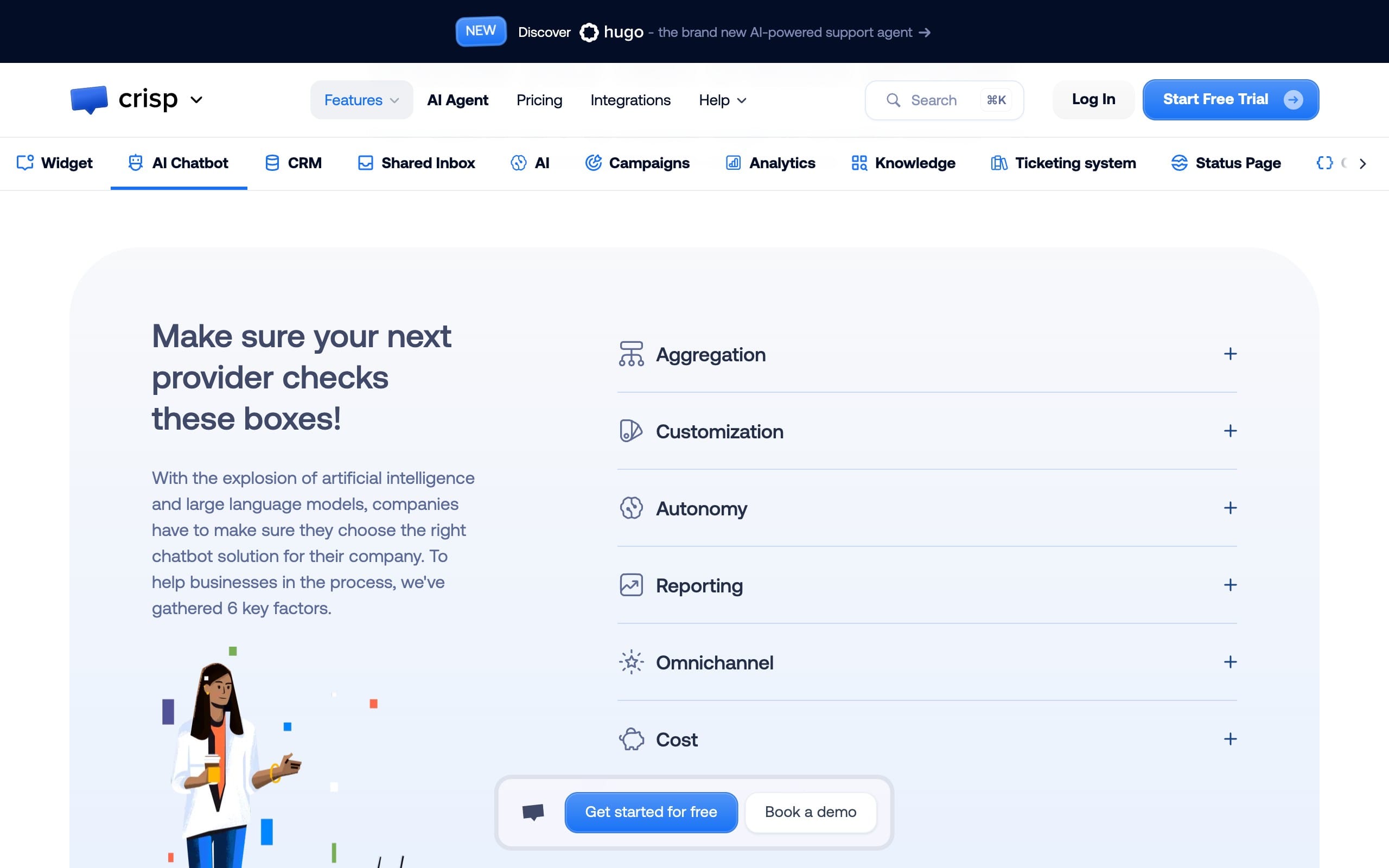
Crisp is an all-in-one messaging platform that bundles live chat, a chatbot, a shared inbox, a knowledge base, and even co-browsing into one affordable unified platform. It is a favorite among startups and SMBs that want broad functionality without per-agent pricing.
A visual chatbot builder automates responses, the shared inbox keeps everyone aligned, and self service tools deflect common questions, while co-browsing lets agents help website visitors directly on the page. Flat workspace pricing keeps costs predictable as you add more team members and your support workload grows.
Pricing: a free tier covers two seats; Mini is €45, Essentials €95, and Plus €295 per workspace/month billed per workspace rather than per agent.
Best for: small teams that want many features in one tool at a flat price.
Limitation: seat limits per tier mean larger teams move up plans to add capacity.
How to choose the best Tidio alternative for your team
Tidio is a fine first step, but as customer expectations and customer support volume grow, the right Tidio alternative depends on what you value most. Start with your primary goal. If you want to deflect tickets with AI-powered automation on your own content, ChatBot is the most direct upgrade. If human support quality is the priority, LiveChat leads. For AI and human support in one platform, Intercom's Fin is the benchmark, while Zendesk wins for enterprise-scale ticketing and reporting.
Match the rest to context. Run a store on Shopify? Gorgias connects customer support to orders and helps grow revenue. Already on HubSpot? Its free live chat keeps everything in the CRM. Need a true free tier, multilingual support, and mobile access? Freshchat and Crisp are strong, low-cost entries, and Manychat owns social and WhatsApp.
Weigh features, free-tier availability, AI pricing, and integrations against your goals, and you can confidently pick a customer service platform that improves customer satisfaction and customer experience as your team scales.
Ready to see AI-powered live chat and support in action? Start a free ChatBot trial and put automation to work on your own content.
Frequently asked questions
Is there a free Tidio alternative?
Yes. HubSpot, Freshchat, Manychat, and Crisp all offer a free plan with a working chat tool and basic features. ChatBot, LiveChat, Intercom, Zendesk, and Gorgias offer free trials rather than permanent free tiers, which suits teams ready to move past basic features into advanced automation.
What is the best Tidio alternative for an ecommerce store?
Gorgias is purpose-built for ecommerce and integrates deeply with Shopify, making it the best fit for stores that want customer support and sales in one helpdesk. Manychat is a strong second for brands that sell through social channels and WhatsApp.
What is the best AI-powered Tidio alternative?
For AI-driven automation, ChatBot and Intercom's Fin lead. ChatBot trains an AI assistant on your own data with AI resolutions included in each plan, while Fin resolves conversations on a per-resolution price across every Intercom plan.
Which Tidio competitor is best for growing teams?
Growing teams that need predictable scaling support and strong reporting tend to land on LiveChat or Zendesk. Both handle rising customer support volume, give visibility into performance, and add agents and channels without forcing a disruptive migration.